Marcela Moraga: What happens in the sky, happens on earth.
Cosmology of an oasis
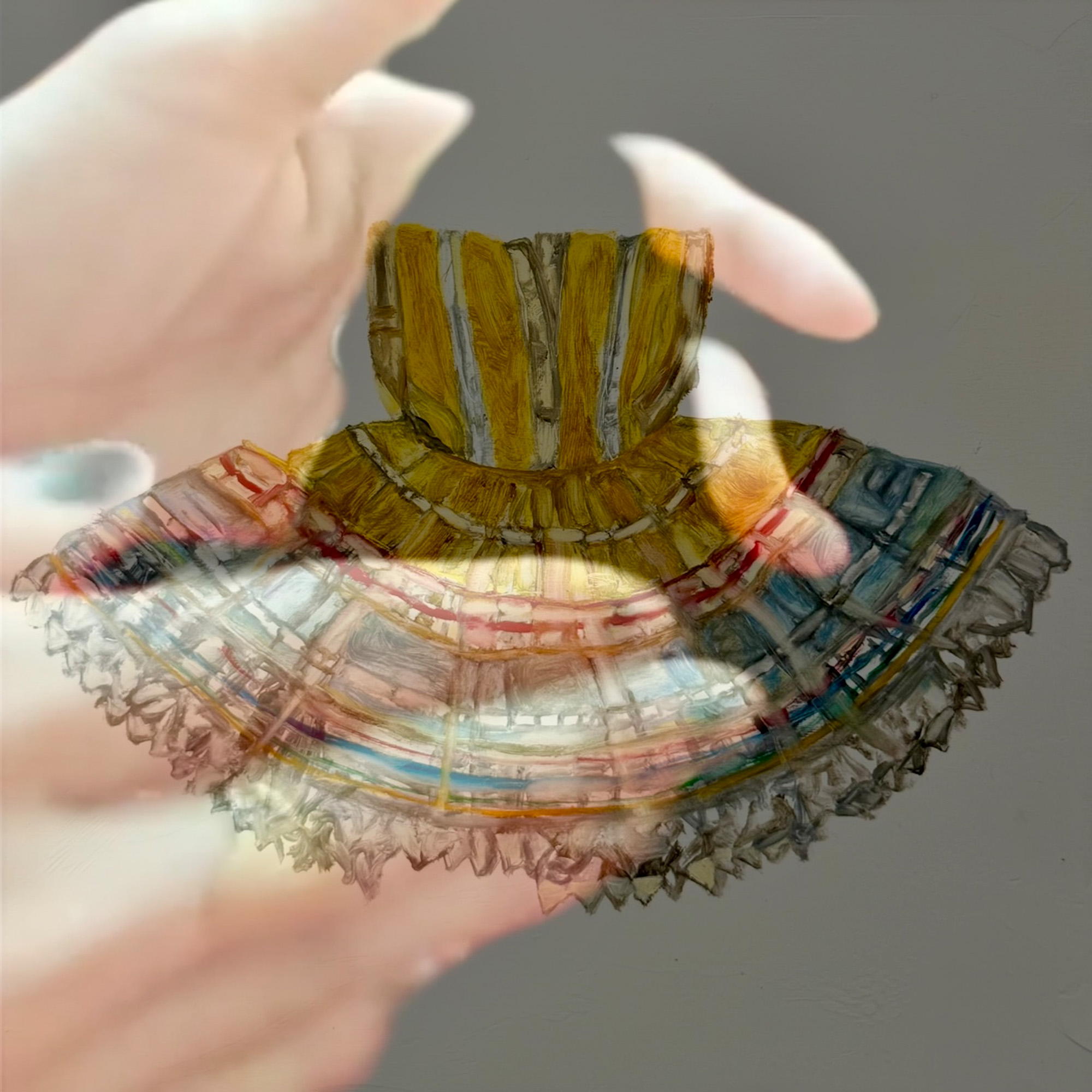
In her textile-based research station, Marcela Moraga explores how the Indigenous Lickanantay people of the Atacama Desert (Chile) understand the sky and the earth as inseparably connected. In collaboration with women from the weaving community of Chiu Chiu and the Indigenous association Lay Lay in Calama, the project interweaves oral traditions, environmental conflicts, and sky observation into ever-changing constellations of knowledge.
At its core is a critique of Western extractivism and the dominance of Western scientific paradigms — of the ways in which mining and modern astronomy have shaped the landscapes and cosmologies of the desert. By rethinking the oasis as a technology of observation and survival, Moraga asks how cooperative practices and Indigenous ecological knowledge might open up alternative relationships between science, land, and care. Visitors encounter woven constellations, archival materials, and field notes, as well as a playful learning space for children that translates cosmological heritage into accessible, imaginative forms.
The project resonates with the research approaches of the Zentrum für Kulturtechnik (ZfK), particularly with the department The Technical Image, whose investigations into visual instruments and image-based knowledge build a conceptual bridge between the laboratory and the landscape.
Visitor Experience
During opening hours, the Tieranatomisches Theater invites visitors to discover it as a landscape of observation and imagination.
On the ground floor, Marcela Moraga’s research station unfolds in the Rotunda, while on the first floor, the immersive installation CALADRI by po:era transforms the Historic Auditorium and the Library into a shifting planetary twilight space from dusk (6:00–9:00 pm).
All spaces are barrier-free and accessible to wheelchair users.
Information about the artistic research projects is available in German and English.
The immersive installation CALADRI can only be experienced in English; the artist talks will also be held in English due to the international audience of Berlin Science Week.
The installations can be visited independently during the week; times when artists and curators are present are listed in the program.
Program Highlights — Night Sky with Open Futures
(as part of anatomia publica × Berlin Science Week)
Saturday, 1 November — Opening of Night Sky with Open Futures
6:00 – 9:00 pm
Wednesday, 5 November — Open Installations & Performative Experiences
2:00 – 9:00 pm | Both artistic research projects are open for independent visits.
Thursday, 6 November — Open Installation & Performative Experiences
Artist Talks: Dialogues under the Night Sky | Location: Object Laboratory, Zentrum für Kulturtechnik (HU Berlin)
4:00 – 5:00 pm Artist Talk Po:era & Miguel Chaparro | 5:30 – 6:30 pm Marcela Moraga & Basilio Solís Castillo
Friday, 7 November — Open Installations & Performative Experiences
2:00 – 9:00 pm | Both artistic research projects are open for independent visits.
Saturday, 8 November — Open Installations & Performative Experiences
Artist Talk
In this conversation, Marcela Moraga continues her research on the cosmology of the Lickanantay oasis culture in the Atacama Desert, where sky observation, weaving, and land care form a single system of knowledge.
Basilio Solís Castillo, astrophysicist and member of the Lickanantay community, introduces this worldview and shows how the bright and dark zones of the sky mirror life on Earth. The discussion explores how academic and vernacular astronomy can meet, and whether the oasis can be understood as a technology of observation and survival.
In connection with artistic, scientific, and heritage research perspectives within the Zentrum für Kulturtechnik, the conversation expands to address the role of instruments of vision, referring to publications by Das Technische Bild (Imagination des Himmels, Instrumente des Sehens, Scientific Fiction) as a material bridge between laboratory and landscape. Together with the audience, the talk invites reflection on forms of seeing, knowing, and imagining – between sky and earth, fiction and fact.
The project by Marcela Moraga is presented as part of the Berlin Science Week at the Tieranatomisches Theater and its residency program anatomia publica.
Paz Ponce – Curator for Mediation & Outreach, TA T
For general questions about our program, please contact us by email or phone:
Email: anatomiapublica.tat@hu-berlin.de / Phone: +49 (0)30 2093 46625
For further information about our residency program, please visit the homepage or TAT Aktuell.
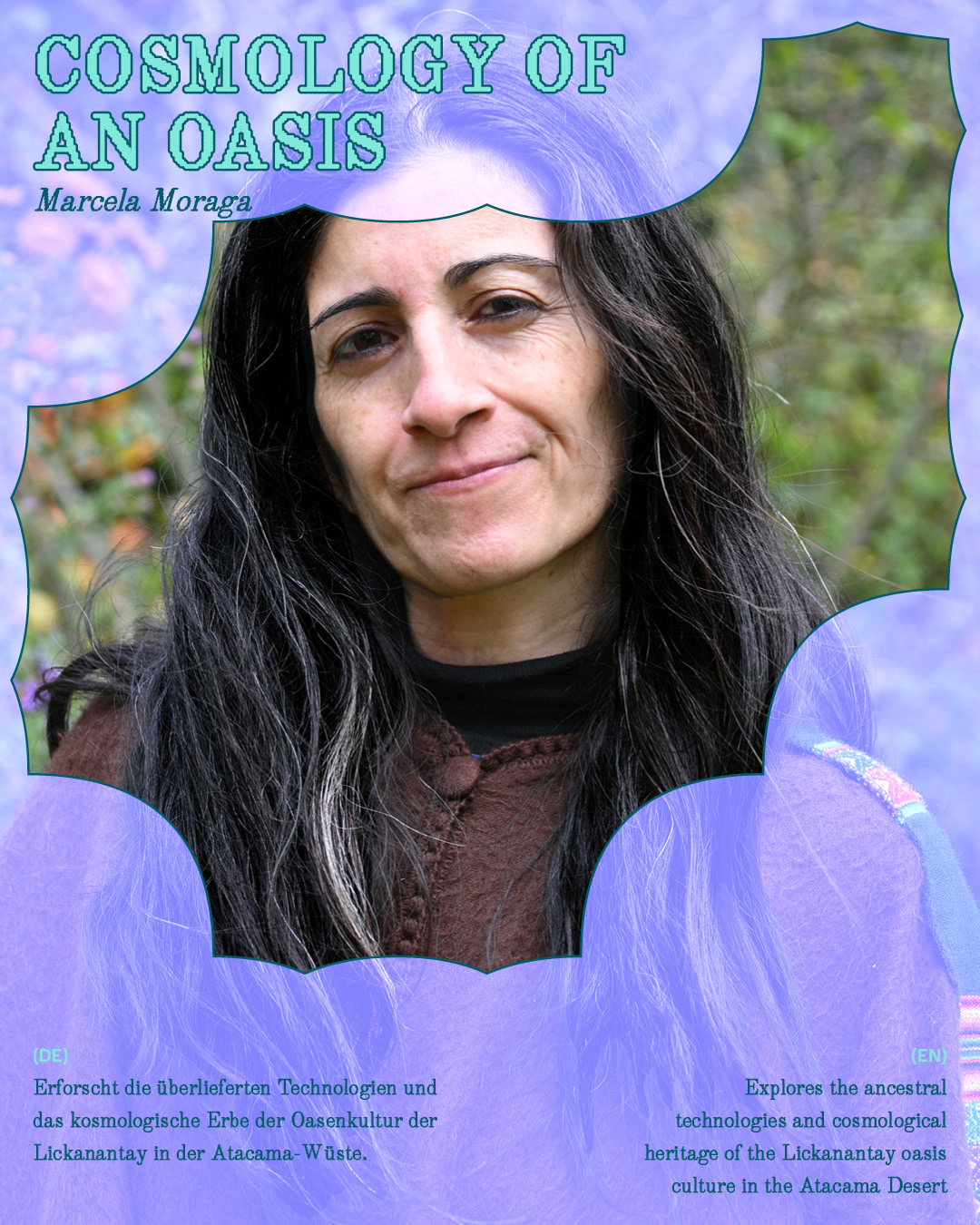
Marcela Moraga obtained her MA in Fine Arts from the University of Chile. She then completed postgraduate studies in Audiovisual Communication at the Hamburg University of Fine Arts and earned a Master’s degree in Art in Context from the Berlin University of the Arts. In her drawings, textiles, and video performances, Marcela Moraga explores the tensions inherent in the duality between nature and culture. Her work focuses on rivers, animals, mountains, plants, and communities affected by resource extraction. Using speculative narratives and fictional methods shaped by spirituality and Indigenous knowledge, Moraga creates new stories that foster connections between humans and non-humans. Her works have been exhibited in numerous venues, including Kunstraum Pavillon am Milchhof (2025, DE), Museo Palacio Pereira (2024/25, CL), and Haus am Lützowplatz (2024, DE).
Further collaborations by Marcela Moraga include Galerie Durchgang (2023, CH), Kunstverein Braunschweig (2022/23, DE), Haus der Kulturen der Welt (2022, DE), nGbK Berlin (2021, DE), Espacio Rozenstraat (2021, NL), Villa Romana (2020, IT), Loop Festival Barcelona (2020, ES), and the Bienal de Nuevos Medios Santiago (2015, CL). She has received several prestigious grants and fellowships from institutions such as Villa Romana e.V., the Senate of Berlin, the Goethe-Institut, nGbK Berlin (Neue Gesellschaft für bildende Kunst), and FONDART (Fondo Nacional para el Desarrollo Cultural y las Artes).
In 2024, Moraga was selected for Connect Chile, a cooperative residency between Arts at CERN and the MIM Science Museum in Santiago, Chile.
Zugehörige Ausstellungen und Veranstaltungen
-
Bhasha Chakrabarti: Archive of Divine Possessions
Mehr: Bhasha Chakrabarti: Archive of Divine Possessions
Impressum
- Prof. Geraat J. Vermeij, PhD Yale (1971), (blinder) Professor, Department for Earth and Planetary Sciences, Marine Ecology and Paleoecology, University of California Davis
- Dr. Amy Bower, (blinde) Meeresbiologin, Gründerin OceanInsight, Woods Hole Oceanographic Institution, angefragt
- Prof. Dr. Siegfried Saeberg, Professor für Disability Studies und Teilhabeforschung an der ev. Hochschule für Soziale Arbeit und Diakonie Rauhes Haus in Hamburg, angefragt
- Prof. Dr. John Nyakatura, Professor für Vergleichende Zoologie, Institut für Biologie, Humboldt-Universität zu Berlin, angefragt
- Prof. Dr. Carsten Lüter, Museum für Naturkunde Berlin, angefragt
- PD Dr. Thomas Stach, Institut für Biologie, Humboldt-Universität zu Berlin
- Prof. Claire Cunningham, Professorin für „Choreography, Dance and Disability Arts“ am Hochschulübergreifenden Zentrum Tanz Berlin (HZT), angefragt
- Dr. Olaf Boebel, Dr. Ilse van Opzeeland, Leitung Ocean Acoustic Group, Alfred-Wegener-Institut für Polar- und Meeresforschung, angefragt
- Prof. Dr. Petra Anders, Professorin für Deutschunterricht und seine Didaktik in der Primarstufe Institut für Erziehungswissenschaften, Humboldt-Universität zu Berlin
- Prof. Dr. Robert Stock, Professor für Kulturen des Wissens, Institut für Kulturwissenschaft, Humboldt-Universität zu Berlin
Kooperation / gefördert durch: