Po:era
Program of events anatomia publica, 1. – 8. November – (Lucas Lacerda & Daniel Weyand)
CALADRI is a speculative research project where astrophysics and fiction converge. Rooted in real scientific data, it imagines a slowly rotating exoplanet where life can survive only within a migrating twilight belt between scorching light and frozen darkness.
PO:ERA
CALADRI is a speculative research project where astrophysics and fiction converge. Rooted in real scientific data, it imagines a slowly rotating exoplanet where life can survive only within a migrating twilight belt between scorching light and frozen darkness. Within this fragile zone, two societies move in constant adaptation — preserving their knowledge in underground echo chambers that archive climate rhythms and celestial signals to transmit memory across deep time.
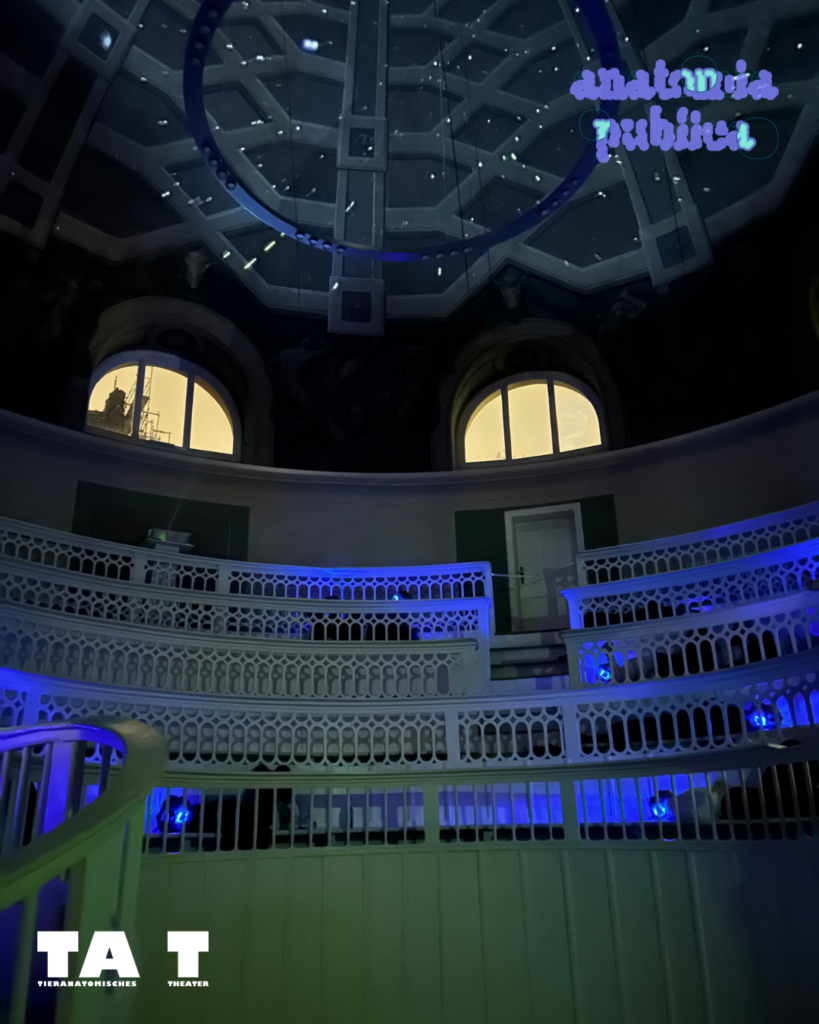
Through sound, video mapping, and narrative fragments, po:era invites visitors to enter an immersive field of perception — part planetarium, part performance.
From dusk onward, the Historic Auditorium transforms into a participatory environment where audiences are invited to listen, speculate, and join worldbuilding sessions exploring coexistence between science and fiction.
In parallel Po:era hosts the fourth edition of the site-specific art festival ONSITE which explores the speculative futures of three cultural sites in Berlin: a museum, cinema, and theatre. Po:era’s world-building project CALADRI – developed as part of their research of Anatomia Publica – will kick off the festival program on 6 November at Tieranatomisches Theater.
During opening hours (14:00–21:00), visitors are invited to explore the Tieranatomisches Theater as a landscape of observation and imagination.
Marcela Moraga’s research station can be experienced in the Rotunda (ground floor), while po:era’s immersive installation activates from dusk (18:00–21:00) in the Historic Auditorium and Library (first floor).
All spaces are barrier-free and wheelchair accessible.
Information about the artistic research projects is available in German and English.
Please note that the immersive experience CALADRI by po:era is presented in English only, and the Artist Talks are held in English due to the international composition of the guests and audience of Berlin Science Week.
The installations can be experienced independently throughout the week, with moments of artist and curator presence announced in the daily programme below.
Paz Ponce – Curator for Public Programmes & Outreach, TA T
Programm Admission
Programmhighlights — Night Sky with Open Futures
(im Rahmen von anatomia publica × Berlin Science Week)
Samstag, 1. November — Eröffnung von Night Sky with Open Futures
18:00 – 21:00 Uhr
Mittwoch, 5. November — Offene Installationen & Performative Erfahrungen
14:00 – 21:00 Uhr I Beide künstlerischen Forschungsprojekte sind für eigenständige Besuche geöffnet.
Donnerstag, 6. November — Offene Installation und Performative Erfahrungen
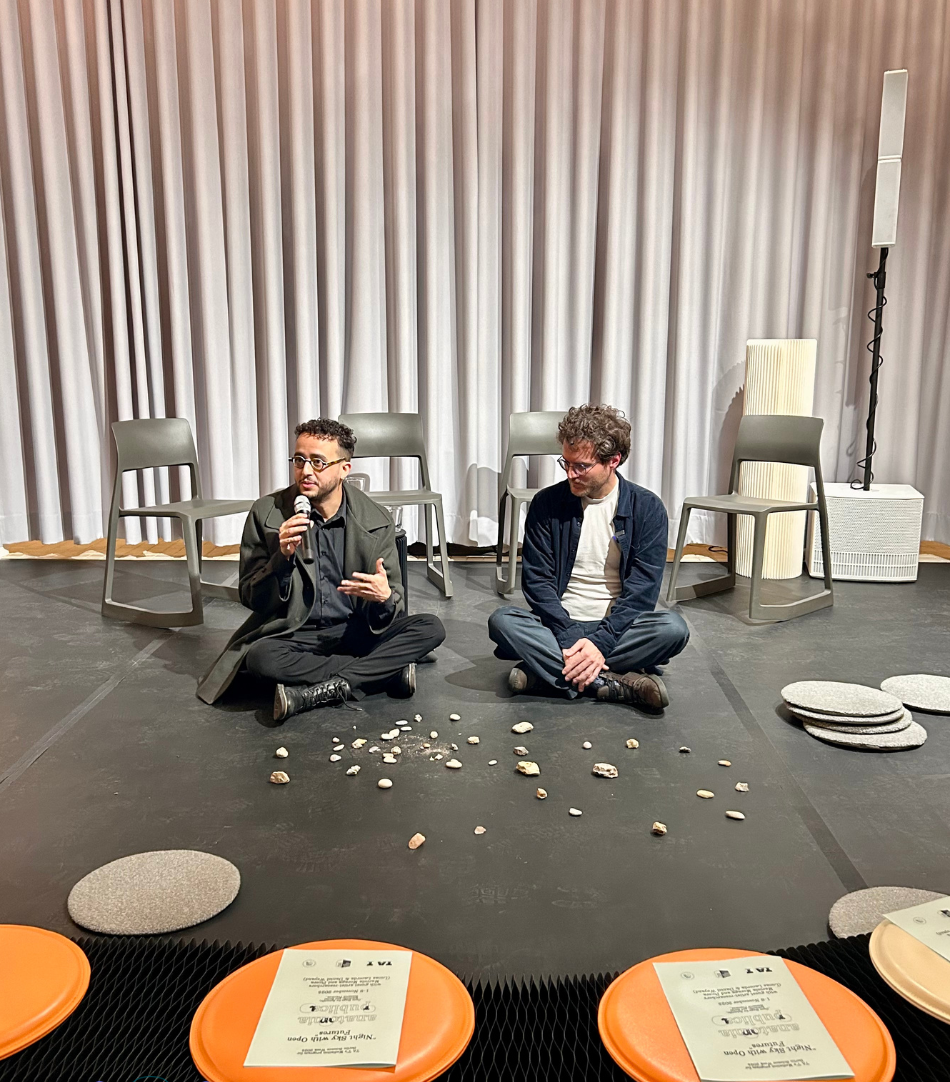
Artist Talks: Dialogues under the Night Sky I Ort: Objektlabor, Zentrum für Kulturtechnik (HU Berlin)
16:00 – 17:00 Uhr Artist Talk Po:era & Miguel Chaparro I 17:30 – 18:30 Uhr Marcela Moraga & Basilio Solís Castillo
Freitag, 7. November — Offene Installationen & Performative Erfahrungen
14:00 – 21:00 Uhr I Beide künstlerischen Forschungsprojekte sind für eigenständige Besuche geöffnet.
Saturday, 8. November — Offene Installationen & Performative Erfahrungen
Artist Talk
Das Gespräch im Objektlabor lädt Wissenschaftler:innen und Besucher:innen aus verwandten Disziplinen – etwa Anthropologie, Klimaforschung, Geografie oder Astrophysik – zu einer gemeinsamen spekulativen Übung ein. Ausgangspunkt sind offene Forschungsfragen und ein von den Künstlern mitgebrachtes Objekt – eine materielle Spur, die ihre fiktionale Welt mit den Realitäten der Erde verbindet. Eingeladene Forscher:innen übernehmen die Rolle von Respondents – ein Format, das aus den performativen Künsten und Forschungssymposien stammt, bei dem Begleiter:innen anderer Disziplinen Resonanzen statt Analysen anbieten. Ihre Beiträge sind nicht erklärend, sondern antwortend, und verknüpfen wissenschaftliche Perspektiven mit poetischen und imaginativen. Gemeinsam mit dem Publikum entfaltet sich das Gespräch als eine Art Science Theater – ein geteilter, spekulativer Raum, in dem sich Wissen und Staunen begegnen. Das Gespräch bildet den Prolog zu der immersiven Installation, die anschließend unter der Kuppel des Tieranatomischen Theaters zu erleben ist, wo Caladri als Erfahrung von Licht, Klang und planetarischer Bewegung erfahrbar wird.
To participate in the Storytelling Circle – How did this dog come into my life?, please register in advance as places are limited:
Email: anatomiapublica.tat@hu-berlin.de / by phone: +49 (0)30 2093 46625
Besuchserlebnis
Während der Öffnungszeiten lädt das Tieranatomische Theater dazu ein, als Landschaft der Beobachtung und Imagination entdeckt zu werden. Im Erdgeschoss entfaltet sich Marcela Moragas Forschungsstation in der Rotunde , während im ersten Stock die immersive Installation CALADRI von po:era mit Einbruch der Dämmerung (18:00 – 21:00 Uhr) den Historischen Hörsaal und die Bibliothek in einen wandelnden planetarischen Dämmerungsraum verwandelt.
Alle Räume sind barrierefrei und rollstuhlgerecht zugänglich.
Informationen zu den künstlerischen Forschungsprojekten sind auf Deutsch und Englisch verfügbar.
Die immersive Installation CALADRI ist nur auf Englisch erfahrbar; die Artist Talks finden aufgrund des internationalen Publikums der Berlin Science Week auf Englisch statt. Die Installationen können während der Woche eigenständig besucht werden; Zeiten mit Anwesenheit der Künstler:innen und Kurator:innen sind im Programm angegeben